2015年5月3日 星期日

Iliad 16. 419-476

主題:  神之子
Iliad 16. 419-476


我沒有特別喜歡希臘神話,但是,希臘神話蘊藏特殊的哲學思維、世界觀與生命觀,值得深思與反省。例如,一個人的生死已定,即使是天神宙斯也不能改變;還有,關於長生不死的問題,希臘神話故事點出問題與缺點,打破世人的迷思。細讀特洛伊戰爭,就會明瞭一件淺顯的道理: 殺人者,終究死在另一人手中,有人說一山還有一山高,但還有細膩的因果觀在當中。

下面的段落出場的是Sarpedon,是宙斯和Laodamia的兒子,在特洛伊中,僅次於Hector的大英雄。但,終究要死在Patroclus手中。宙斯不捨,早已開始憂傷兒子將死; 天后是出於好意,還是因為吃醋,總之,她出面阻擋宙斯救兒子,她的邏輯清晰,主要三點論點: 第一,不可能改變命運; 第二,其他眾神也會反對,因為每個神都有自己的兒子,在戰場上搏鬥,隨時會結束生命,如果宙斯救Sarpedon,眾神都模仿,會引起大亂;第三,真心愛小孩,就該放手,交給命運,能送他的是起睡神和死神送他回故土,給他最好的葬禮與尊榮。

神之子,在世或許比一般人璀璨英勇,但還是化做一堆塵土,連神也沒辦法改變。


τὸν δ᾽ ἠμείβετ᾽ ἔπειτα βοῶπις πότνια Ἥρη:
αἰνότατε Κρονίδη ποῖον τὸν μῦθον ἔειπες.
‘ἄνδρα θνητὸν ἐόντα πάλαι πεπρωμένον αἴσῃ
ἂψ ἐθέλεις θανάτοιο δυσηχέος ἐξαναλῦσαι;
ἔρδ᾽: ἀτὰρ οὔ τοι πάντες ἐπαινέομεν θεοὶ ἄλλοι.
ἄλλο δέ τοι ἐρέω, σὺ δ᾽ ἐνὶ φρεσὶ βάλλεο σῇσιν:
αἴ κε ζὼν πέμψῃς Σαρπηδόνα ὃν δὲ δόμον δέ,
φράζεο μή τις ἔπειτα θεῶν ἐθέλῃσι καὶ ἄλλος
πέμπειν ὃν φίλον υἱὸν ἀπὸ κρατερῆς ὑσμίνης:
πολλοὶ γὰρ περὶ ἄστυ μέγα Πριάμοιο μάχονται
υἱέες ἀθανάτων, τοῖσιν κότον αἰνὸν ἐνήσεις.
ἀλλ᾽ εἴ τοι φίλος ἐστί, τεὸν δ᾽ ὀλοφύρεται ἦτορ,
ἤτοι μέν μιν ἔασον ἐνὶ κρατερῇ ὑσμίνῃ
χέρσ᾽ ὕπο Πατρόκλοιο Μενοιτιάδαο δαμῆναι:
αὐτὰρ ἐπὴν δὴ τόν γε λίπῃ ψυχή τε καὶ αἰών,
πέμπειν μιν θάνατόν τε φέρειν καὶ νήδυμον ὕπνον
εἰς ὅ κε δὴ Λυκίης εὐρείης δῆμον ἵκωνται,
ἔνθά ἑ ταρχύσουσι κασίγνητοί τε ἔται τε
τύμβῳ τε στήλῃ τε: τὸ γὰρ γέρας ἐστὶ θανόντων. (Iliad 16.439-457)

Ox-eyed queen Hera then replied to Zeus:                                “Dread son of Cronos, how can you say this? The man is mortal,
doomed long ago by Fate. Now you desire
to rescue him from miserable death.
Do as you wish. But we other gods   
will not all agree with you. And I’ll tell you
something else—make sure you remember it.
If you send Sarpedon home alive,
take care some other god does not desire
to send his dear son from the killing zone.
Around Priam’s great city, many men,
sons of the immortals, are now fighting.
You’ll enrage those gods and make them bitter.
But if Sarpedon’s dear to you, if your heart  
feels pity for him, then let him be killed  
in a fierce combat at Patroclus’ hands,
son of Menoetius. Once his living spirit
has abandoned him, send Death and sweet Sleep
to carry him away, back to the spacious land
of Lycia, where his brother and his kinsmen
will bury him with a mound and headstone.
That’s what appropriate for those who die.”

以下圖片與資料出處:  http://en.wikipedia.org/wiki/Sarpedon
The death of Sarpedon, depicted in Lycian attire, at the hands of Patroclus. Red-figure hydria from Heraclea, c.400 BCE.


2015年4月25日 星期六

Iliad 16.198-277

主題: Achilles的禱告
Iliad 16.198-277


《伊利亞特》第十六卷168-197行寫到Achilles還幫Patroclus先部署好他率領的五十艘船艦的部隊,分成五大隊;出發前還用一段演講,激勵人心,當中提到,大家都說Achilles的母親為他的是膽汁(Iliad 16. 203-206),不是牛奶,所以他脾氣暴躁,沒有同情心。這段話,顯然是因為之前Patroclus提到Achilles的蠻狠(Iliad 16. 33ff),大英雄真的很在意這些話。此外,傳說中Achilles小時候也是送到人馬獸Cheiron那兒學習,有一說法,那兒的主要飲食是野獸的血與肉。不管怎樣,Achilles用這番話激勵人心,大家士氣大增,準備號迎敵。

Achilles的部隊人數並不多,但是有一特色是,合作團結,在Achilles的訓練下,他們排出緊密的隊形,向高牆堆砌的石磚,密不通風,固若磐石。這一群團結的部隊,向一群團結的狼 (Iliad 16.156 ff),也像攻擊力強的馬蜂(Iliad 16.259-265)。

這些準備還不夠,Achilles還是不放心,所以,打開從家鄉運來的寶箱,拿出最好的金盃裝酒,獻給宙斯並為Patroclus和他帶出去的部隊禱告 (Iliad 16. 220-230),祈求他們旗開得勝,並平安歸來。這個願望只會實現一半。
這隻寶箱,有點像今天出國必帶的登機箱或行李箱,是母親Thetis為Achilles準備,裏頭裝有衣物和必要的器皿等。Achilles拿出上等的杯子,還先用硫磺洗淨,再裝酒(Iliad 16. 228-30)。古希臘硫磺洗滌,有清潔與宗教的意義,θέειον (sulphur)的字根就是神 (θεο-),味道又和宙斯的閃電類似。另一個有名的例子是Odysseus 在殺了眾多霸佔他們家多年的惡霸,也用硫磺潔淨他的家(Odyssey 22. 481 ff),一方面洗除血跡,一方面也有神聖的洗滌之意義。


             αὐτὰρ Ἀχιλλεὺς
βῆ ῥ᾽ ἴμεν ἐς κλισίην, χηλοῦ δ᾽ ἀπὸ πῶμ᾽ ἀνέῳγε
καλῆς δαιδαλέης, τήν οἱ Θέτις ἀργυρόπεζα
θῆκ᾽ ἐπὶ νηὸς ἄγεσθαι ἐῢ πλήσασα χιτώνων
χλαινάων τ᾽ ἀνεμοσκεπέων οὔλων τε ταπήτων.
ἔνθα δέ οἱ δέπας ἔσκε τετυγμένον, οὐδέ τις ἄλλος
οὔτ᾽ ἀνδρῶν πίνεσκεν ἀπ᾽ αὐτοῦ αἴθοπα οἶνον,
οὔτέ τεῳ σπένδεσκε θεῶν, ὅτε μὴ Διὶ πατρί.
τό ῥα τότ᾽ ἐκ χηλοῖο λαβὼν ἐκάθηρε θεείῳ
πρῶτον, ἔπειτα δ᾽ ἔνιψ᾽ ὕδατος καλῇσι ῥοῇσι,
νίψατο δ᾽ αὐτὸς χεῖρας, ἀφύσσατο δ᾽ αἴθοπα οἶνον. (Iliad 16. 220-30)

Achilles went into his hut and opened up the lid
on a beautifully decorated chest
placed on board his ship by silver-footed Thetis
for him to take. She’d packed it with cloaks and tunics,
and woollen blankets, too—protection from the wind.
There he kept an ornate goblet. Other than Achilles   
no one used it to drink gleaming wine. With this cup
Achilles poured libations to no god but Father Zeus.
Taking this out of the chest, first he purified it
with sulphur, then rinsed it out in streams of water.
He washed his hands and drew some gleaming wine.  

字彙
χηλός large chest, coffer  
θέειον (sulphur)          


Iliad 16.101-197


主題: 披掛上陣,但是....
Iliad 16.101-197

大家都知道因為阿奇里斯因為和阿加曼儂不合而拒絕作戰時,Patroclus披上他的盔甲,領導邁爾彌頓人(Myrmidons)殺了許多特洛伊人,包括了Sarpedon (宙斯與歐羅芭之子)與赫克特(Hector)的雙輪馬車駕駛Cebriones。最終,在太陽神阿波羅(Apollo)的幫助下,他被Hector所殺。
  但是,一般人都沒注意到,史詩紀載雖然Patroclus披上阿奇里斯的盔甲,卻沒使用阿奇里斯的的投槍(spear),因為這投槍又大又重,除了阿奇里斯,沒人拿得動。
  這支槍大有來頭,還有專有名稱: 佩利昂梣木槍 (the Pelian spear of ash),是Cheiron 佩利昂高峰取得,贈給阿奇里斯父親,也是寶貴又神奇的傳家寶。
   少一把投槍,其實真正少的是能力與實力,Patroclus終究不是阿奇里斯,終究輸給Hector。阿奇里斯還是把他的副手推向死亡,一套戰袍,根本無法保護脆弱的生命。


ἔγχος δ᾽ οὐχ ἕλετ᾽ οἶον ἀμύμονος Αἰακίδαο
βριθὺ μέγα στιβαρόν: τὸ μὲν οὐ δύνατ᾽ ἄλλος Ἀχαιῶν
πάλλειν, ἀλλά μιν οἶος ἐπίστατο πῆλαι Ἀχιλλεὺς
Πηλιάδα μελίην, τὴν πατρὶ φίλῳ πόρε Χείρων
Πηλίου ἐκ κορυφῆς, φόνον ἔμμεναι ἡρώεσσιν.
ἵππους δ᾽ Αὐτομέδοντα θοῶς ζευγνῦμεν ἄνωγε,
τὸν μετ᾽ Ἀχιλλῆα ῥηξήνορα τῖε μάλιστα,
πιστότατος δέ οἱ ἔσκε μάχῃ ἔνι μεῖναι ὁμοκλήν.
τῷ δὲ καὶ Αὐτομέδων ὕπαγε ζυγὸν ὠκέας ἵππους
Ξάνθον καὶ Βαλίον, τὼ ἅμα πνοιῇσι πετέσθην,
τοὺς ἔτεκε Ζεφύρῳ ἀνέμῳ Ἅρπυια Ποδάργη
βοσκομένη λειμῶνι παρὰ ῥόον Ὠκεανοῖο.
ἐν δὲ παρηορίῃσιν ἀμύμονα Πήδασον ἵει,
τόν ῥά ποτ᾽ Ἠετίωνος ἑλὼν πόλιν ἤγαγ᾽ Ἀχιλλεύς,
ὃς καὶ θνητὸς ἐὼν ἕπεθ᾽ ἵπποις ἀθανάτοισι. (Iliad 16. 140-54)

He’d didn’t choose Achilles’ spear,   
for no Achaean man could wield that weapon,
so heavy, huge, and strong, except for brave Achilles.   
It was made of ash wood from the peak of Pelion.
Cheiron gave it to Achilles’ father to kill warriors.
Patroclus told Automedon to yoke the horses quickly,
the man he most esteemed after Achilles,
breaker of men, and the one he trusted most
to carry out his orders in a battle.
For Patroclus Automedon put swift horses
in the harnesses, Xanthus and Balius, who flew along
as swiftly as the wind. These horses Podarge,
the harpy, had conceived with West Wind, as she grazed 
in a meadow beside the stream of Oceanus.

字彙
Μελία: manna ash, Fraxinus Ornus


以下圖片與資料出處: http://en.wikipedia.org/wiki/Patroclus

The body of Patroclus is lifted by Menelaus and Meriones while Odysseus and others look on (Etruscan relief, 2nd century BC)

以下圖片與資料出處: http://www.sunnyfotini.com/blogfiles/Pilion.htm
Pelion, land of the legendary Centaurs, the site chosen by the ancient gods for their weddings and celebrations, rises in lush magnificence to the northeast of Volos . It was here that the centaur Chiron, the wise teacher of demigods and heroes, gave his pupils daily instruction in the proper care of body and soul. Here, as well, the first beauty contest took place between Thetis and Eris. Many-leaved Pelion was an inspiration to Homer, Pindar, and Euripides but also to the modern popular muse who sung of the unquenchable desire of the Greek people for freedom.


2015年4月13日 星期一

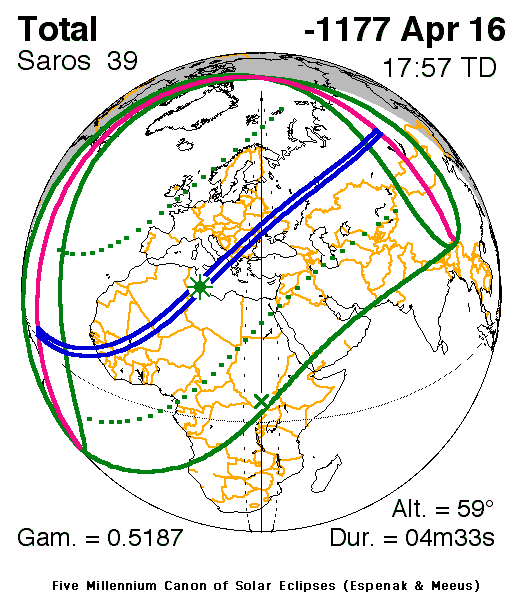
古代日蝕

資料ㄧ: 維基百科基本資訊
http://zh.wikipedia.org/wiki/%E6%97%A5%E9%A3%9F
日食,又寫作「日蝕」,是一種天文現象,只在月球運行至太陽與地球之間時發生。這時,對地球上的部分地區來說,月球位於太陽前方,因此來自太陽的部分或全部光線被擋住,看起來好像是太陽的一部分或全部消失了。日食只在朔,即月球與太陽呈現合的狀態時發生。
日食分為四種,包括日全食、日環食、日偏食及全環食,其中較罕見的是全環食,只發生在地球表面與月球本影尖端非常接近的情形下,這時不同地區會出現日偏食、日全食和日環食三種不同的日食。日全食是一種相當壯麗的自然景象,所以經常吸引許多遊客和天文愛好者特地到海外去觀賞日全食。例如,在1999年8月11日日食發生在歐洲的日全食,吸引了非常多觀光客特地前去觀賞,也有旅行社推出專門為這些遊客設計的行程。

資料二: 古代日食列表


_________________________
嘉陵驛(唐·薛能)
題注:一作題嘉陵江驛


江濤千疊閣千層,銜尾相隨盡室登。
稠樹蔽山聞杜宇,午煙薰日食嘉陵。

頻題石上程多破,暫歇泉邊起不能。
如此幸非名利切,益州來日合攜僧。
_____________________________________

2015年4月12日 星期日

太陽不見了,二讀Odyssey 20.352-357


去年閱讀這段文字,沒有注意到日蝕的比喻。
http://etwonderland.blogspot.tw/2014/06/odyssey-20-345-394.html


ἆ δειλοί, τί κακὸν τόδε πάσχετε; νυκτὶ μὲν ὑμέων
εἰλύαται κεφαλαί τε πρόσωπά τε νέρθε τε γοῦνα.
οἰμωγὴ δὲ δέδηε, δεδάκρυνται δὲ παρειαί,
αἵματι δ᾽ ἐρράδαται τοῖχοι καλαί τε μεσόδμαι:
εἰδώλων δὲ πλέον πρόθυρον, πλείη δὲ καὶ αὐλή,
ἱεμένων Ἔρεβόσδε ὑπὸ ζόφον: ἠέλιος δὲ
οὐρανοῦ ἐξαπόλωλε, κακὴ δ᾽ ἐπιδέδρομεν ἀχλύς.
(Odyssey 20. 352-357)

“O you miserable men, what troubles
are you suffering now? Your heads, your faces,
your lower limbs are shrouded in the night.
You’re on fire with grief, faces wet with tears,
fine pedestals and walls have gobs of blood,
the porch is full of ghosts, so is the yard—
ghosts rushing in the dark to Erebus.
Up in the sky the sun has disappeared—
an evil mist is covering everything.
被標示出的文字是356-357行 ἠέλιος δὲ οὐρανοῦ ἐξαπόλωλε, κακὴ δ᾽ ἐπιδέδρομεν ἀχλύς (Up in the sky the sun has disappeared—an evil mist is covering everything).....太陽不見了!
  
 2008年National Geographic出了一篇文章,引起不少關注,也有不少中文媒體轉報導相似訊息:

http://news.nationalgeographic.com/news/2008/06/080623-homer-eclipse.html?hc_location=ufi

Ancient Eclipse Found in "The Odyssey," Scientists Say

Richard A. Lovett
for National Geographic News
June 23, 2008
"The sun has perished out of heaven, and an evil mist has overspread the world."
With those words in The Odyssey, Homer laid down not a prophecy of doom but a description of a real-world total solar eclipse, scientific sleuths announced today.
It has been known for decades that there was only one such eclipse during the time period Homer wrote about in the ancient Greek poem—on April 16, 1178 B.C. The blackout even occurred at noon, as described in the epic poem.
But without additional evidence, the idea that Homer's passage describes an eclipse has been pooh-poohed by Homeric scholars.
Now scientists have looked into additional astronomical descriptions in The Odyssey and found them to be consistent with that date for the noontime darkness.
The references relate to moon phases and positions of constellations and planets—phenomena that rarely occur in the sequence described in Homer's work—physicist Marcelo Magnasco said by email. Magnasco co-authored the new study with fellow Rockefeller University scholar Constantino Baikouzis, an astronomer.
The scientists used astronomical software to simulate the Greek skies, night by night, over a 135-year period surrounding the eclipse.
Even without using the eclipse itself in their calculations, the researchers found only one date for the noontime darkness: April 16, 1178 B.C.


Scientific American也有報導


http://www.scientificamerican.com/article/homers-odyssey-may-document-eclipse/


Researchers say that references to planets and constellations in the Odyssey describe asolar eclipse that occurred in 1178 B.C., nearly three centuries before Homer is believed to have written the story. If correct, the finding would suggest that the ancient poet had a surprisingly detailed knowledge of astronomy.
The Odyssey, commonly dated to near 800 B.C., describes the 10-year voyage of the Greek general Odysseus to his home on the island of Ithaca after the fall of Troy in approximately 1200 B.C. Toward the end of the story, a seer named Theoclymenus prophecies the death of a group of suitors competing for the affection of Penelope, the wife of Odysseus, who is believed to be dead. Theoclymenus delivers his prophecy as the suitors are sitting down for their noontime meal. He foresees them entering Hades and ends his speech with the statement, "The Sun has been obliterated from the sky, and an unlucky darkness invades the world." Odysseus dispatches the suitors not long thereafter.
Greek scholars Plutarch and Heraclitus advanced the idea that Theoclymenus's speech was a poetic description of an eclipse. They cited references in the story that the day of the prophecy was a new moon, which would be true of an eclipse. In the 1920s researchers speculated that Homer might have had a real eclipse in mind, after calculating that a total solar eclipse (in which the moon blocks out the sun) would have been visible on April 16, 1178 B.C. over the Ionian Islands, where Homer's poem was set. The idea languished, however, because the first writings on Greek astronomydid not come until centuries later.
Inspired by an incorrect reference to Homer's alleged eclipse in an astronomy textbook, biophysicists Constantino Baikouzis and Marcelo Magnasco, both at the Rockefeller University, pored over the Odyssey for additional clues. Sailing back to Ithaca on a raft, Odysseus navigates by monitoring the constellations Pleiades and Bootes, which share the sky twice a year in March and September. The morning he arrives in Ithaca, Venus rises in the sky before dawn, which happens on about one third of new moons. But the crucial clue came from a reference to the god Hermes flying west to the island of Ogygia. The researchers propose the god's voyage actually refers to the planet Mercury, which hangs low in the sky and reverses course from west to east every 116 days.
Baikouzis and Magnasco used commercial astronomical software to scan all 1,684 new moons between the years 1250 and 1125 B.C. for dates that matched those conditions. "Even though each event happens individually often, the pattern doesn't repeat that often," Magnasco says—only once every 2,000 years, he and Baikouzis report inProceedings of the National Academy of Sciences USA. And one of those matches is April 16, 1178 B.C. Magnasco says that he had a hunch about Hermes, known as Mercury to the Romans, after coming across the idea that the Greeks used the stories of the gods as mnemonic devices to remember astronomical events. Taking Mercury out of the mix leaves 15 matching dates in the 135-year search period, he adds.
According to Magnasco, the references imply that Homer chose to set the slaying of the suitors on the day of the eclipse. (He notes that he has "no clue" whether similar events to those described in the Odyssey actually occurred on that day.)

《奧德賽》史詩描述3千年前日蝕現象


http://big5.ce.cn/gate/big5/sci.ce.cn/funny/03/200806/26/t20080626_15965644.shtml?hc_location=ufi

據美國國家地理雜誌報道,“太陽在天空中毀滅,邪惡的薄霧蔓延整個世界……”這是荷馬所著古希臘史詩《奧德賽》中的內容,目前科學家宣稱,《奧德賽》準確地紀錄了當時的一次日蝕現象,看來荷馬並未預言世界末日,而是描述了現實世界中所出現的日蝕現象。
在荷馬所著的《奧德賽》中描述了西元前1178年4月16日,當天中午突然出現日蝕,原本的太陽黯然失色。但是由於沒有其他的附加證據,該章節中所描述的日蝕現象被同時期的學者們所嘲笑。目前,科學家觀測了《奧德賽》中這段天文學描述,發現荷馬所描述的與真實日蝕現象發生時間相一致。
物理學家馬塞羅?馬格納斯科稱,荷馬所在章節中所描述的月球狀態和星座及行星的位置與實際情況相符。與馬格納斯科共同完成這項最新研究的合著作者是洛克菲勒大學天文學家康斯坦汀諾?貝庫茲斯。他們使用天文學軟體模擬了希臘天空和晝夜變化,每隔135年出現一次日蝕現象。最終推算顯示西元前1178年4月16日中午出現日蝕,這與《奧德賽》中所描述相一致。

http://www.uux.cn/viewnews-35584.html
荷马在《奥德赛》中描述到:“太阳在苍穹中死亡,而邪恶之雾遍布世界。”根据国家地理杂志的报道,事实上荷马提到的是发生于公元前1178年4月16日的巨大日食。日食对人类造成了一种重大的影响,人们习惯于把它看做是一种厄运来临的象征。比如说,在中国古代人们认为日食是有一条龙正在试着毁灭我们的太阳。

其他轉載與報導:

  1. http://newswire.rockefeller.edu/2008/06/23/celestial-clues-hint-at-eclipse-in-homers-odyssey/
  2. http://www.newrepublic.com/blog/the-study/90045/total-eclipse-the-odyssey
  3. 古希臘文或拉丁文關於日蝕或可能是日蝕的描述: http://hbar.phys.msu.su/gorm/atext/ginzele_.htm?hc_location=ufi
  4. HOMER’S SECRET ODYSSEY  http://www.epicstars.org.uk/?hc_location=u


重新找回Marcelo Magnasco 發表的論文

Is an eclipse described in the Odyssey?

http://www.pnas.org/content/early/2008/06/23/0803317105.abstract

Abstract
Plutarch and Heraclitus believed a certain passage in the 20th book of the Odyssey (“Theoclymenus's prophecy”) to be a poetic description of a total solar eclipse. In the late 1920s, Schoch and Neugebauer computed that the solar eclipse of 16 April 1178 B.C.E. was total over the Ionian Islands and was the only suitable eclipse in more than a century to agree with classical estimates of the decade-earlier sack of Troy around 1192–1184 B.C.E. However, much skepticism remains about whether the verses refer to this, or any, eclipse. To contribute to the issue independently of the disputed eclipse reference, we analyze other astronomical references in the Epic, without assuming the existence of an eclipse, and search for dates matching the astronomical phenomena we believe they describe. We use three overt astronomical references in the epic: to Boötes and the Pleiades, Venus, and the New Moon; we supplement them with a conjectural identification of Hermes's trip to Ogygia as relating to the motion of planet Mercury. Performing an exhaustive search of all possible dates in the span 1250–1115 B.C., we looked to match these phenomena in the order and manner that the text describes. In that period, a single date closely matches our references: 16 April 1178 B.C.E. We speculate that these references, plus the disputed eclipse reference, may refer to that specific eclipse.


可以聽聽訪談:
Big Think Interview With Marcelo Magnasco


還有2013年古典學家Peter Painsford的 回應:
Odyssey 20.356-57 and the Eclipse of 1178 BCE: A Response to Baikouzis and Magnasco
http://www.academia.edu/622261/Odyssey_20.356-57_and_the_Eclipse_of_1178_BCE_A_Response_to_Baikouzis_and_Magnasco


回歸閱讀Heubeck的註釋本:


荷馬史詩中的太陽神Helios


這個推論,間接提出奧德修斯回家日期,再推算出特洛伊戰爭年代;不過,別忘了,Marcelo Magnasco是先假設特洛伊戰爭發生在1200 BCE左右,所以,用此方法推回特洛伊戰爭時間,邏輯上是嚴重錯誤。

《白鯨記》

大學時代讀的小說《白鯨記》,大都似懂非懂。星期六的演講,我再次回想過去讀書,好像「瞎子摸鯨」..... 。我到現在還有點迷糊,藍鯨,是藍色? 白鯨,是白色?
"There is a wisdom that is woe; but there is a woe that is madness. And there is a Catskill eagle in some souls that can alike dive down into the blackest gorges, and soar out of them again and become invisible in the sunny spaces. And even if he for ever flies within the gorge, that gorge is in the mountains; so that even in his lowest swoop the mountain eagle is still higher than other birds upon the plain, even though they soar."
--from MOBY DICK by Herman
Melvillehttps://www.facebook.com/HermanMelvilleAuthorPage/photos/a.338966019556071.78059.338950349557638/751014101684592/?type=1&theater


藍鯨
  • 1866年6月15日在瑞典首都斯德哥爾摩舉辦歐洲藝術及工業展覽(Konst-och industriutställningen),奧斯卡(Oscar)王子及勒維莎(Lovisa)王妃親臨現場。
  • 在當時瑞典第二大城哥特堡自然歷史博物館(Göteborgs Naturhistoriska museum)有展示世界上最大鯨魚藍鯨展示,此鯨魚於1865年10月29日擱淺在哥特堡南方Näset外海,體長16公尺,經該博物館做成標本,並於當年12月對外展示。


中華科技史學會例會演講筆記 (2)

《中西聞見錄》第16號第23頁(1873年11月)鯨傷電線

講者陳德勤先生從這則報導,思考當時各國的海底電纜、捕鯨業的興衰。

--> 過度捕鯨造成鯨類族群大量減少
-->石油開發減少使用鯨油造成捕鯨業衰退
*** 古代的投影機,稱作 鏡影燈
(Magic Lantern),原本使用鯨油,但漸漸被煤油與石油取代


鏡影燈(Magic Lantern)
以下圖片來源: http://www.phoenixmasonry.org/masonicmuseum/Magic_Lantern_with_EA_FC_MM_Slides.htm


以下圖片來源:   http://www.oobject.com/12-magic-lanterns/chinese-magic-lantern-by-aubert-1879/2510/